

By SEO Nic, SEO Veteran Since 2006
The Story Nobody Tells You About Ranking
Here’s a confession that might surprise you: I’ve spent the better part of two decades getting clients to the first page of Google, over 90% of their major keyword terms, year after year, and I never once promoted my own website using SEO.
Crazy, right?
I was too busy winning for everyone else to think about myself. But 2026 is different. And if I’m going to put my own name out there, I’m going to do it right, with the truth, not the fluff.
So let me tell you what’s actually happening in search right now. Not what the “gurus” are selling. Not what worked in 2020. What’s working right now.
The Big Shift Nobody’s Talking About
Google’s March 2026 core update just finished rolling out, and it wasn’t subtle. Nearly 80% of top-three URLs shifted positions. One in four top-10 pages fell out of the top 100 entirely.
If you’re still playing the SEO game the way you did five years ago, you’re not just losing ground, you’re becoming invisible.
Here’s what the data actually shows about ranking in 2026.
The 9 Factors That Actually Matter (and the Myths You Need to Stop Believing)
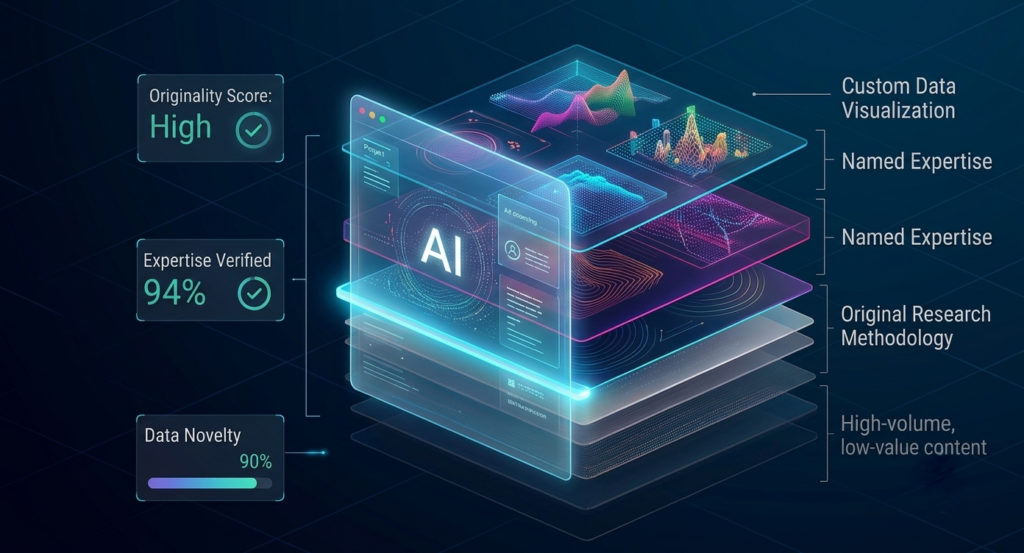
1. Content That Proves You’ve Done the Work
The old playbook said “content is king.” The new reality? Helpful, original content is emperor, and everything else is just nobility trying to get invited to the banquet.
Google’s “Helpful Content Update” is hyper-focused on ranking content that’s written for and by people rather than content made primarily for search engine traffic. But there’s a subtlety here most people miss.
What Google actually measures: When Google’s internal Search API documentation leaked in May 2024, it confirmed a signal called contentEffort, AI-powered estimation of how much human effort went into your content. While the leak itself was in 2024, these underlying signals represent the foundation of how Google evaluates quality in 2026 and beyond. The system is scanning for:
- Original data and custom visualisations
- Expert quotes from named practitioners
- Content that’s genuinely differentiated from what already ranks
- Proprietary research (even anonymised client data counts)
The story behind the signal: When I first started SEO in 2006, you could rank with 300-word articles that repeated your keyword 12 times. Today, I’ve seen 5,000-word articles lose to 1,200-word pieces that included a single original stat.
One “Helpful” page with 5 links now outranks a “Thin” page with 50 links. Think about that. Google would rather show a well-crafted piece with minimal external validation than a hollow one with tons of artificial authority.
What to do: Lead with proprietary data. Write in first-person from named expertise. Show your methodology. Stock images don’t raise your contentEffort, your custom charts and screenshots do.
2. The “SiteAuthority” Signal They Denied for a Decade
This is the SEO story you haven’t heard.
When Google’s internal API documentation leaked in May 2024, it confirmed something the company had publicly denied for years: they do use Chrome browser data to measure site authority.
There’s a signal called chromeInTotal that aggregates:
- How frequently people visit your site
- How long they stay
- How much direct traffic you get
A quick nuance on chromeInTotal: While Chrome data directly feeds this signal, it’s important to understand that Google primarily uses it for traffic baselines and entity verification, establishing whether your site is a genuine, recognised entity with real-world visitation patterns, rather than as a direct “ranking score booster.” It’s less about “this signal gives you +X ranking points” and more about “this confirms you’re a legitimate, recognised entity.”
The conspiracy theory that turned out to be true: For years, SEOs suspected Google was watching Chrome behaviour. Google said we were paranoid. The leak proved we weren’t paranoid enough.
What to do: You can’t fake direct traffic. You can’t buy your way into people’s browsing habits. Build a brand people actually want to visit. Be the site they type into their browser, not just the one they find by accident.
3. Topical Authority (Not Just Domain Authority)
This is where things get interesting.
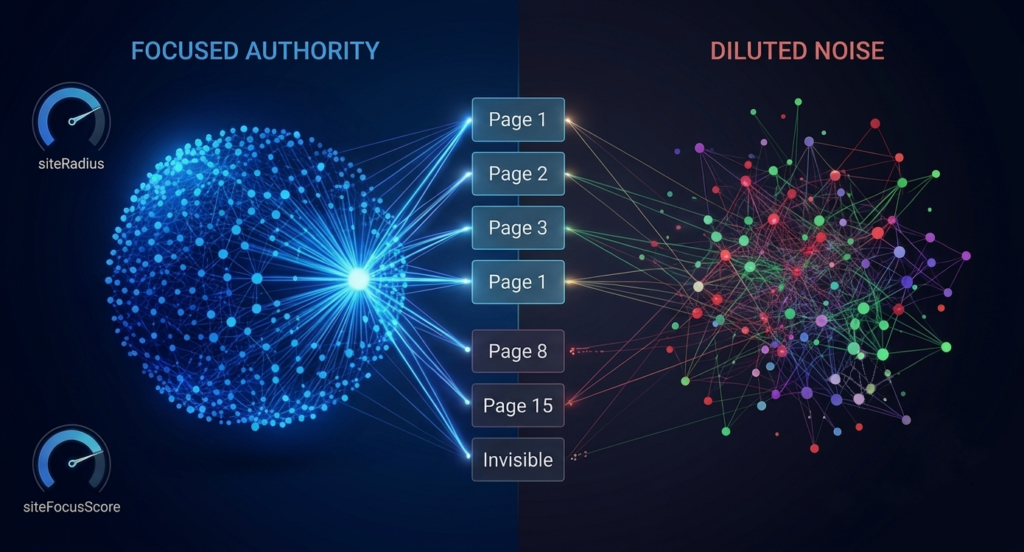
Google now measures siteFocusScore, how concentrated your site is on a single topic, and siteRadius, which tracks how far individual pages stray from your site’s topical center.
The implication: A site that’s deeply focused on one topic gets a massive advantage over a generalist site trying to cover everything.
The real-world lesson: If you run a site about digital marketing and you occasionally write about productivity hacks, you’re diluting your topical authority. Every off-topic post makes it harder to rank for the topics that actually matter to your business.
4. Backlinks: The Entry Ticket vs. The Accelerator
Here’s the nuanced truth about backlinks in 2026: You don’t need them to rank in positions 8-15. Ahrefs research suggests over 70% of SEO professionals believe it’s possible to rank with quality content alone, especially for low-competition, long-tail keywords.
But here’s the catch: Want position #1? You’ll need backlinks.
The data is brutal:
- The #1 ranking page has 3.8× more backlinks than positions 2-10
- 95% of sites ranking top 10 for commercial keywords have 1,000+ backlinks
- 76% of pages cited in AI Overviews also rank in Google’s top 10
The gold standard in 2026: Digital PR through platforms like HARO and Qwoted. Earn editorial links from publications that are already covering your topic. Research-backed content and original studies have the highest response rate because they give journalists something concrete to cite.
What the leak revealed: Google doesn’t treat all links equally. The leaked documentation suggests they classify links into low, medium, and high-quality tiers based in part on click data, with low-tier links simply ignored.
5. User Experience: What Google’s Actually Measuring
Google’s RankBrain algorithm is essentially a massive user behaviour study. It measures:
- Dwell time: How long people spend on your page after clicking from search results
- Click-through rate: Whether people actually click your result when it’s shown
- Pogo-sticking: When users click your result, then click back to the search results and try something else
The 2026 reality: Pages where users spend meaningful time send positive signals. Quick bounces do the opposite.
The leaked API confirmed what many suspected: Google tracks something called goodClicks, badClicks, and lastLongestClicks. They know when a user is satisfied and when they’re not.
They know if you delivered the answer or if the user had to keep searching.
Mobile matters more than ever: 53% of mobile users abandon a site that takes longer than three seconds to load. Google uses actual Chrome user data to evaluate loading speed, not just lab tests.
6. Structured Data: From “Nice to Have” to “Get In or Get Left Behind”
This might be the most important shift nobody’s talking about.
Structured data has moved from being a nice-to-have optional boost to a baseline requirement for eligibility in AI-driven search, shopping, and comparison experiences.
The new reality: If you’re not using Schema markup, you’re not just missing a ranking opportunity, you’re making yourself invisible to the AI systems that are increasingly acting as the front door to search.
7. The Death of Traditional Keyword Optimisation
Remember when you could cram a keyword into every sentence and rank?
That era is over.
Google’s algorithm evolution tells the story:
- 2012 (Penguin): Targeted keyword stuffing
- 2013 (Hummingbird): Introduced semantic search
- 2015 (RankBrain): Added machine learning for intent understanding
- 2019 (BERT): Dramatically improved context understanding
- 2022 (Helpful Content Update): Reinforced writing for people, not search engines
What still matters: Title tags, H1 headers, natural keyword placement in the first 100 words, and semantic keywords that reinforce topical relevance.
What doesn’t: Meta keywords (ignored since 2009), exact keyword matching, keyword density formulas, and over-optimised anchor text.
8. Brand Signals: The New Authority
Google’s March 2026 core update showed visibility moving away from aggregators and directories toward established brands and specialist platforms.
What they’re measuring:
- Branded search volume
- Brand mentions (linked AND unlinked)
- Legitimacy of your social media presence
- Your reputation on sites like Yelp
- Whether you have a physical location
The leak revealed something fascinating: Google can identify authors and treat them as “entities” in the system. Publishing under recognised, credible bylines isn’t just good practice, it’s an actual ranking signal.
9. The AI Overviews Factor
AI Overviews appear in more than 25% of searches. This has fundamentally reshaped how content gets surfaced.
The goal of SEO is no longer just to rank in organic search results, it’s to get cited in AI-generated answers.
What that means for you:
- Clear structure and direct answers (FAQ formats work well)
- E-E-A-T signals (Experience, Expertise, Authoritativeness, Trustworthiness)
- Structured data that helps AI understand your content
- Brand mentions that build trust with AI systems
The Myths You Can Finally Stop Believing
“Domain age helps” – Google’s John Mueller has said domain age “helps nothing.”
“Meta keywords matter” – Google hasn’t used them since 2009.
“Social signals are a direct ranking factor” – Google has stated they don’t directly affect search rankings.
“You need to publish constantly” – Authority, clarity, and maintenance of fewer strong assets outperform high-volume publishing.
“Duplicate content will get you penalised” – Google filters duplicate content; they don’t penalise it.
What I’ve Learned From 20 Years of Doing This
Since 2006, I’ve watched SEO evolve from keyword-stuffing to semantic search to AI-powered understanding. Here’s what I know for sure:
The fundamentals still work: Quality content, authoritative backlinks, technical soundness, and user experience are still the foundation. But the definition of each has evolved significantly.
Google is getting smarter about quality: They can tell the difference between AI-generated content that’s been lightly edited and genuinely original work. They can tell when you’ve actually done the research versus when you’ve just summarised what’s already out there.
Brand matters more than ever: The sites that win long-term are the ones people actually know and trust. Not because of SEO tricks, but because they’ve built something worth remembering.
User experience is the new SEO: If your site frustrates people, Google will notice. If it delights them, Google will reward you.
Your Action Plan for 2026
- Audit your content for originality. Does it offer something unique? Does it demonstrate genuine expertise?
- Build your topical authority. Focus on what you’re truly an expert in. Let the generalists fight over scraps.
- Earn editorial backlinks. Not directory links. Not guest post links. Real editorial coverage from legitimate publications.
- Optimise for user experience. Speed, mobile-friendliness, and ease of navigation aren’t optional.
- Implement structured data. It’s no longer optional, it’s how AI finds you.
- Build your brand. Be the site people search for by name. Be the one that gets mentioned, linked or unlinked.
- Stop gaming the system. Every time Google releases an update, the sites using tricks get buried. The sites doing honest work survive.
My Promise to You
I’ve been doing SEO since 2006. I’ve helped countless clients rank on the first page for 90%+ of their major keyword terms. And now I’m finally using what I know to build something for myself.
You can expect the same honesty, the same data-driven approach, and the same commitment to doing SEO the right way, not the easy way, in everything I publish going forward.
Let’s rank!